
The Australian property industry has become very good at setting sustainability targets. Net zero by 2040. Electrification by 2035. Carbon-neutral operations. Climate resilience. ESG leadership. But there is an uncomfortable truth few property owners, investors and operators want to discuss:
Most organisations cannot accurately describe the condition, remaining life, replacement cost or performance of the assets that sit inside their buildings.
If that’s the case, do they really have a net-zero strategy? Or just a target?
According to the Commercial Buildings Baseline Study 2026, Australia’s non-residential building stock is expected to grow significantly over coming decades, while simultaneously transitioning away from gas, increasing electrification and reducing operational emissions. Delivering that transition will require real investment decisions at building level, not merely corporate commitments.
The Industry Has Confused Ambition with Readiness
Many property portfolios still contain:
- Ageing HVAC systems nearing end of life.
- Electrical infrastructure unable to support building electrification.
- Incomplete asset registers.
- Deferred maintenance backlogs.
- Unfunded capital liabilities.
- Poor building performance data.
- Limited visibility of future replacement requirements.
None of these problems disappear because an organisation publishes an ESG strategy.
In fact, emerging climate disclosure requirements are increasingly focused on governance, risk management, metrics, targets and demonstrable evidence. Organisations are being asked to prove not only what they intend to achieve, but how they intend to achieve it.
A NABERS Rating Is Not an Asset Strategy
A building can achieve a respectable NABERS rating while still carrying significant future liabilities.
A chiller may operate adequately today while being only two years from replacement.
A building management system may provide data without delivering meaningful operational insights.
A lighting upgrade may improve energy performance while ignoring ageing switchboards incapable of supporting broader electrification initiatives.
The reality is simple:
Building performance and asset readiness are not the same thing.
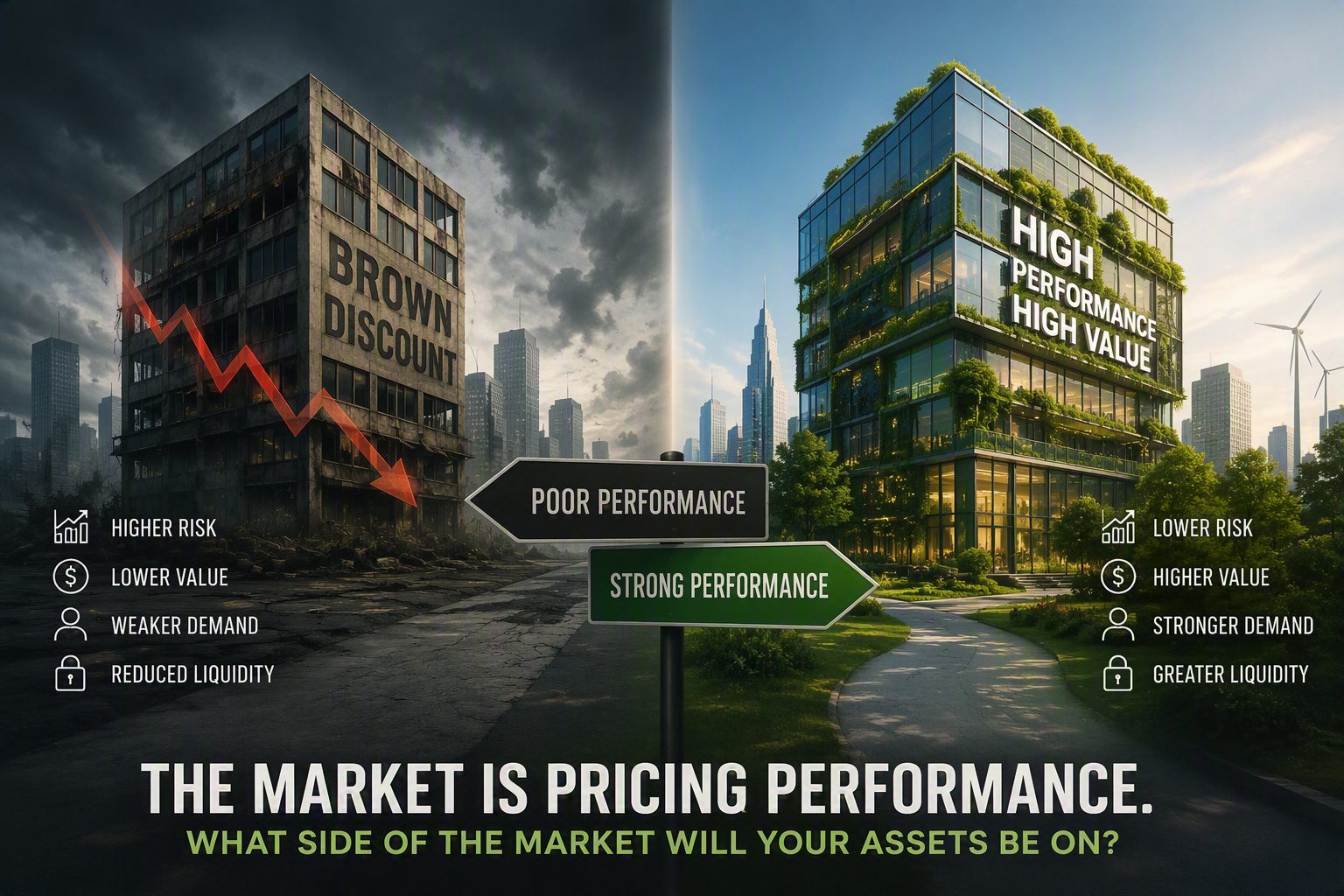
Current market commentary is increasingly identifying a divide between “future-ready” buildings and everything else.
ESG-ready assets are attracting stronger investor interest, tenant demand and capital allocation, while secondary assets are facing growing pressure to reposition or upgrade.
The Real Stranded Asset Risk Is Poor Visibility
The industry talks constantly about stranded assets.
Yet poor-performing assets can be fixed.
Equipment can be replaced.
Buildings can be repositioned.
Capital can be allocated.
The bigger risk is not knowing what the problem is until it impacts a:
- Valuation
- Lease renewal
- Tenant retention decision
- Due diligence process
- Insurance renewal
- Compliance review
- Climate disclosure
- Critical plant failure
At that point, management is no longer making strategic decisions.
They are reacting.
And reactive capital expenditure is almost always more expensive than planned capital expenditure.
Boards Need Asset Intelligence, Not More ESG Presentations
Every Board and executive team should be able to answer six simple questions:
- What assets do we own?
- What condition are they in?
- What is their remaining useful life?
- What risks do they present?
- What capital investment will be required?
- How do these investments improve value, resilience and sustainability outcomes?
If management cannot answer those questions with confidence, then any long-term decarbonisation strategy rests on weak foundations.
The solution is not another ESG workshop.
The solution is a clear understanding of:
- Asset condition
- Asset performance
- Compliance obligations
Lifecycle requirements - Future capital expenditure
- Investment priorities
In other words:
You cannot decarbonise a portfolio you do not understand.
Capital Planning Is Becoming a Governance Issue
Historically, capital planning was viewed as an operational matter.
Today it intersects with:
- Climate risk
- Financial reporting
- ESG disclosures
- Operational resilience
- Tenant expectations
- Investor confidence
- Asset liquidity
The Commercial Buildings Baseline Study 2026 separately tracks energy efficiency, electrification, EV charging, refrigerants and embodied carbon, highlighting how closely future building performance is tied to capital investment decisions.
Consequently:
A ten-year capital plan without decarbonisation is incomplete.
A net-zero strategy without an asset condition assessment is equally incomplete.
The Uncomfortable Conclusion
Some buildings will never achieve modern ESG expectations without significant investment.
Some portfolios are carrying hidden liabilities that Boards have not yet identified.
Some organisations have published sustainability commitments that are disconnected from the condition of their physical assets.
And some capital plans underestimate future funding requirements by millions of dollars.
The winners over the next decade will not necessarily be those with the boldest sustainability statements.
They will be those that possess the best asset intelligence.
Because the market is increasingly rewarding demonstrable performance, resilience and investment readiness, not simply ambition.
How Redd Zebra Can Help
At Redd Zebra, we believe the first step toward improving sustainability performance is understanding the condition, risk and future capital requirements of your portfolio. Through our Portfolio Health Check™, we help property owners, investors and operators identify the investment gap between asset reality and strategic ambition.
Before announcing your next target, ask a simpler question:
Do you actually know what is happening inside your buildings?
Contact us
For more information about how Redd Zebra can help, contact us on admin@reddzebra.com visit their website at www.reddzebra.com.