
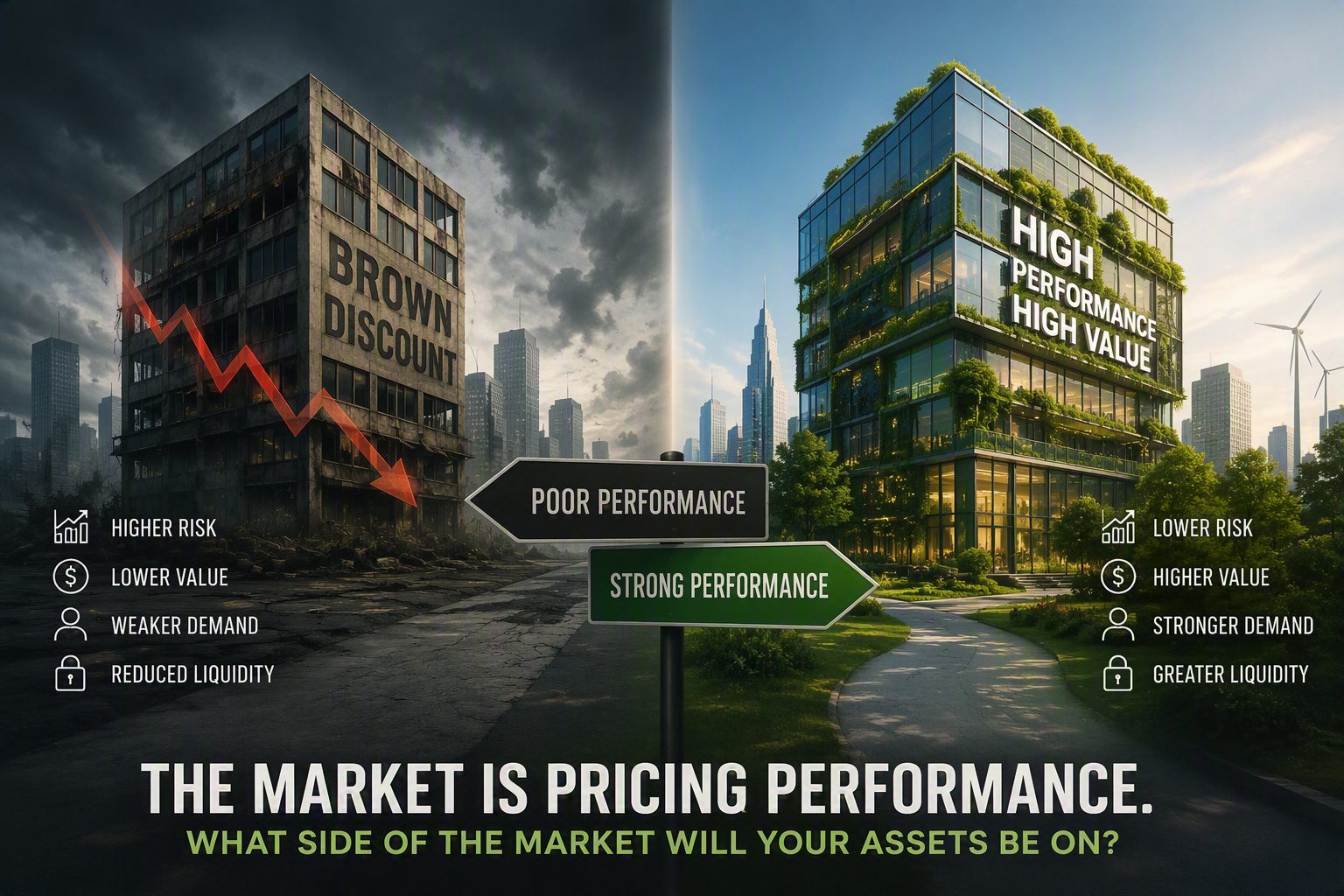
The market may be talking about ESG. But increasingly it is pricing asset performance. JLL’s research on Retrofitting Buildings to be Future-Fit highlights growing evidence of a “brown discount”, where inefficient buildings face reduced liquidity, weaker demand and declining values as investors and occupiers favour high-performing assets.
CBRE similarly warns that commercial assets failing to align with future decarbonisation pathways face increasing transition risk and potential stranding as market expectations evolve. The real risk isn’t failing to publish an ESG report.
The real risk is owning a building that needs an ESG report to explain why it’s underperforming.
The Hybrid Work Parallel
The sustainability conversation mirrors another challenge facing commercial property. Reality eventually catches up with industry narratives.
In our article“Hybrid Work Has Already Devalued Commercial Property – The Industry Just Won’t Admit It”, we argued that workplace demand has fundamentally changed regardless of whether landlords choose to acknowledge it. The same principle applies to ESG.
Investors, lenders and occupiers ultimately care about outcomes.
- Occupancy matters.
- Operating costs matter.
- Asset condition matters.
- Capital planning matters.
- Lifecycle management matters.
Markets reward performance, not intentions.
The Retrofit Revolution
The World Economic Forum argues that creating net-zero cities depends largely on upgrading and retrofitting existing buildings because most of the buildings needed in 2050 already exist today. Similarly, a joint World Economic Forum and McKinsey study describes retrofits as one of the most effective and economically viable pathways toward built-environment decarbonisation. PwC further notes that well-executed sustainability strategies can simultaneously reduce operating costs, increase portfolio value and improve profitability. This highlights an important distinction:
ESG outcomes are often the result of effective asset management rather than effective reporting.
The organisations that win over the next decade will likely focus less on describing sustainability and more on delivering it through:
- Asset condition assessments
- Lifecycle planning
- Capital forecasting
- Building optimisation
- Data-driven decision making
- Portfolio repositioning
AI May Change Everything
Technology is rapidly making asset performance impossible to hide. As discussed in our article “AI in Australia’s Commercial Property Market: The Present and the Road Ahead“, artificial intelligence is providing unprecedented visibility into building performance, utilisation patterns, maintenance requirements and investment priorities.
The winners will not necessarily be those generating more reports. They will be those making better decisions.
What If We’re Measuring The Wrong Thing?
Deloitte’s research highlights that many real estate executives still struggle to connect sustainability initiatives with measurable financial outcomes despite growing pressure from investors, regulators and occupiers. Perhaps the industry’s biggest mistake has been treating ESG as a compliance exercise rather than an asset performance strategy. Instead of asking: “How comprehensive is our ESG reporting?” Boards may achieve better outcomes by asking: “Can we demonstrate that our ESG strategy has materially improved asset performance?”
Because if sustainability isn’t improving resilience, reducing operating costs, strengthening asset performance and protecting long-term value…What exactly are we measuring?
Think Differently
Perhaps ESG isn’t the problem. Perhaps reporting has become the distraction. The objective was never to produce better reports. The objective was to create better assets. When asset performance improves:
- Energy efficiency improves.
- Carbon outcomes improve.
- Resilience improves.
- Occupier experience improves.
- Investment performance improves.
And when that happens, sustainability becomes the outcome, not the headline.
How Redd Zebra Can Help
Redd Zebra has always focused on enabling better decisions, optimised outcomes and creating shareholder value for organisations that own, manage, operate, finance and invest in property. For more information about how Redd Zebra can help, contact us on admin@reddzebra.com visit their website at www.reddzebra.com.